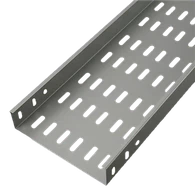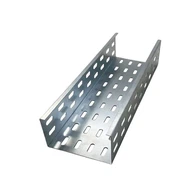


Product parameters
| Product Name: | Stainless Steel Cable Tray |
| Type: | cable tray/channel cable tray/perforated cable tray/tray type cable tray/stainless cable tray/ss cable tray with cover/stainless steel tubing tray/stainless steel wire basket tray/stainless steel wire tray/stainless basket tray |
| Material: | 201 Stainless Steel/304 Stainless Steel/316 Stainless Steel/316L Stainless Steel |
| Surface Treatment: | Passivation |
Product Size:
| Width: | 50-1200mm |
| Side Rail Height: | 25-300mm |
| Length: | 2000mm,3000-6000mm or Customization |
| Thickness: | 0.6-3mm |
Steel Thickness (Recommend)
| 1.0mm-Width: | 50~100mm |
| 1.2mm-Width: | 100~150mm |
| 1.5mm--Width: | 200~500mm |
| 2.0mm--Width: | 600~700mm |
| 2.5mm--Width: | 800~1000mm |
| Customized according to customer requirements | |
Other Characteristics
| Color: | As customer requirements |
| Certification: | CMA/ILAC-MRA/CNAS/CE |
| Application: | Wiring system,cable management,electromechanical system,construction industry and so on. |
| Non standard specifications are availabe according to customer's requirement. | |
Advantages of stainless steel cable trays
1. Excellent corrosion resistance: Stainless steel (such as 304, 316, etc.) can withstand a variety of corrosive environments such as acid, alkali, and salt spray. It is especially suitable for harsh working conditions such as chemical, marine, and humid conditions, and its service life is far longer than that of ordinary steel or aluminum alloy trays.
2. High strength and light weight: Stainless steel has high strength and good rigidity, can carry a large number of cables and is not easy to deform; at the same time, it is lighter than cast iron and other materials, easy to carry and install, and reduces construction costs.
3. High temperature resistance and strong fire resistance: Stainless steel has good high temperature resistance. It can still maintain structural stability in high temperature environments (such as industrial kilns and near thermal pipelines), and it does not burn itself, which meets fire protection requirements and improves system safety.
4. Beautiful surface and easy maintenance: The surface is smooth and clean, which can maintain long-term beauty and is suitable for places with high environmental requirements (such as commercial buildings, medical facilities, etc.); no frequent painting and maintenance is required, simple cleaning, and saves later maintenance costs.
5. Good adaptability and scalability: supports a variety of specifications, models and installation methods (such as trough, tray, ladder), can be flexibly matched with elbows, tees, crosses and other accessories to adapt to complex cable directions; easy to connect and adjust during later expansion or modification.
6. Environmental protection and sustainability: stainless steel materials can be recycled, in line with the concept of green building, reducing resource waste; it is not easy to produce rust debris during long-term use, avoiding pollution to cables or the environment.
7. Strong anti-electromagnetic interference ability: the metal structure can effectively shield electromagnetic signals and protect precision cables from interference. It is suitable for scenes with high requirements for electromagnetic environment such as data centers and communication rooms.
Installation method of stainless steel cable trays
Suspended installation
Applicable scenarios: installation under the ceiling, high-altitude installation
Installation points:
Use stainless steel hangers or wire ropes for suspension
The distance between hangers is ≤1.5m (1.2m when overloaded)
Anti-sway brackets need to be installed (essential for vibration sites)
The distance between layers is ≥300mm for multi-layer installation
01
Wall-mounted installation
Applicable scenarios: laying along the wall, side walls of the pipe gallery
Installation points:
Use L-shaped or U-shaped stainless steel brackets
Expansion bolts need to be made of 316 stainless steel (anti-corrosion)
The wall needs to be pre-buried with steel plates (concrete walls) or reinforced (lightweight partition walls)
Install diagonal braces at corners for reinforcement
02
Column support installation
Applicable scenarios: ground installation, main channel between equipment
Installation points:
Column spacing ≤ 2m (deflection needs to be calculated when the span is large)
The foundation needs to be treated to prevent settlement (outdoor venue)
It is recommended to use an adjustable base (±50mm height adjustment)
03
Hybrid installation
Applicable scenarios: complex path laying
Typical combination:
Horizontal section suspension + vertical section wall hanging
Main road column support + branch line wall hanging
04
Maintenance recommendations for stainless steel cable trays

Routine inspection (recommended once a quarter)
Inspect the connection parts: use a torque wrench to tighten the bolts (especially in vibrating places)
Surface condition inspection: focus on observing whether there are stress cracks at the welding seams and corners
Ground continuity test: use a micro-ohmmeter to measure the cross-connection resistance (standard ≤0.1Ω)
Cleaning and maintenance
General environment: clean with a neutral detergent (pH6-8) at least once a year
Special environment:
• Coastal/chemical zone: spray stainless steel protective agent after cleaning every six months
• Food/pharmaceutical workshop: use food-grade stainless steel cleaner
Anti-corrosion maintenance
When surface scratches are found:
• Depth <0.1mm: use a stainless steel polishing wheel for processing
• Depth>0.1mm: Need to first argon arc welding repair welding and then polishing
Chloride ion enriched area: It is recommended to perform professional passivation treatment every 2 years
Structural safety monitoring
Load inspection: When the newly added cable exceeds the design load by 15%, the load-bearing capacity needs to be recalculated
Deformation monitoring: Use a laser rangefinder to check the mid-span deflection (should be
Seismic components: Perform seismic performance testing every 3 years according to GB50981 requirements
Maintenance and replacement standards
Situations for immediate replacement:
✓ Through cracks appear
✓ Pitting depth>20% of plate thickness
✓ Connection hole deformation leads to fastening failure
Professional maintenance requirements:
• Must use welding wire of the same material (such as ER308L)
• Re-passivation is required after maintenance
Hot Tags: stainless steel cable tray, China stainless steel cable tray manufacturers, suppliers, factory, cable support truck, cable support wagon, wire support truck, wire support wagon