


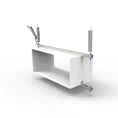
Duct Seismic Bracing
What is Duct Seismic Bracing?
Seismic duct supports are specialized protective devices designed for building ventilation and air conditioning duct systems. Their core function is to effectively control duct displacement during earthquakes through a scientifically designed support and restraint system. This system utilizes high-strength steel and specialized seismic components, transferring seismic forces from the ductwork to the building structure via a multi-directional restraint mechanism. This prevents the ductwork from deforming, detaching, or colliding with other equipment due to violent shaking. Through a precisely calculated diagonal bracing system and hinged mechanisms, this support provides necessary seismic rigidity while allowing for thermal expansion and contraction of the ductwork under normal operating conditions. This ensures that vital systems such as ventilation and smoke extraction maintain their integrity and functionality during earthquakes, making it an important component of modern building seismic-resistant systems.
Analysis of core technologies and detailed system architecture of duct seismic bracing
Its core technologies are embodied in three dimensions
Three-dimensional constraint mechanism: Through lateral and longitudinal dual constraint subsystems, a spatial protection system is formed, effectively controlling multi-directional displacement of pipelines.
Dynamic response design: Utilizing a patented articulated mechanism, it ensures rigid constraint during earthquakes while allowing thermal displacement under normal operating conditions.
Energy dissipation capacity: Through damping elements and special structural design, it effectively absorbs seismic energy and reduces peak loads.
The system comprises four main modules
Main load-bearing structure (channel steel guide rails, seismic bracing)
Professional seismic components (two-way constraint mechanism, damping clamps)
Anchoring force transmission system (mechanical anchors, beam clamp system)
Specialized accessory system (adjustment devices, detection components)


Why can't ordinary duct supports replace dedicated seismic-resistant duct supports?

Fundamental Differences in Design Philosophy
Ordinary duct supports only consider vertical static load support, their design goal limited to bearing the duct's own weight and normal operating loads. Seismic-resistant duct supports, on the other hand, are engineering systems specifically designed to withstand dynamic seismic loads, achieving three-dimensional protection through multi-directional restraint mechanisms. This fundamental difference determines that they play completely different roles in the building safety system—the former is the foundation support, the latter is the safety guarantee.

Significant Differences in Technical Performance
In terms of mechanical performance, ordinary supports use rigid connections, making them highly susceptible to instantaneous failure due to stress concentration during earthquakes. In contrast, seismic-resistant supports possess intelligent dynamic response capabilities, achieving a "rigid-flexible" engineering philosophy through precise hinge mechanisms and damping designs. Their unique load transfer path and energy dissipation mechanism can systematically transmit seismic forces to the main building structure—a technical characteristic that ordinary supports completely lack.

Strict Classification of Safety Standards
From a safety standard perspective, ordinary duct supports do not require seismic testing verification, while seismic-resistant supports must pass rigorous dynamic testing certification (such as ASTM E580 standard). The anchoring system of each seismic-resistant support needs to be professionally calculated and verified, and its installation position and spacing must meet seismic code requirements. This difference in standards directly determines that under seismic loading, ordinary supports may fail due to multi-directional seismic forces, leading to secondary disasters, while seismic-resistant supports ensure that the duct system maintains controlled movement within a safe range.
What is the installation process for duct seismic bracing?
Verify the relevant design drawings for the duct seismic bracing, clarifying the bracing model, installation location, spacing, and diagonal bracing direction to ensure complete compatibility with duct specifications and building structure. Prepare construction tools such as impact drills, wrenches, and levels, as well as materials such as bracing components, anchor bolts, and washers. Carefully inspect product quality to ensure there is no rust or deformation and that all accessories are complete. Clean the installation area, ensuring the building structure's base (beams, slabs, columns) is flat, solid, and free of obstructions that could affect subsequent installation operations.
According to the design drawings, accurately mark the bracing installation points on the building structure and ductwork. Lateral bracing must be perpendicular to the duct axis, longitudinal bracing parallel to the duct axis, and the specific locations of the diagonal braces for bidirectional bracing must be clearly marked. Use levels and measuring tapes to calibrate the positioning points, strictly controlling the bracing spacing (e.g., lateral bracing should not exceed 12m) to ensure that bracing on the same axis is arranged neatly and consistently, laying the foundation for subsequent installation accuracy.
Drill holes according to the positioning marks. The hole diameter must precisely match the anchor bolt specifications. After drilling, promptly clean dust and debris from the holes to avoid affecting the anchor bolt fixing effect. Install chemical or mechanical anchor bolts, ensuring the anchor bolt insertion depth meets the standard (usually not less than 10d, where d is the anchor bolt diameter). After the anchor bolts have cured, carefully check their firmness to prevent loosening and ensure the stability of the support foundation.
Align and fix the support base with the anchor bolts. Tighten the nuts with a wrench to ensure the base remains horizontal and tightly fitted to the structural base. Install the support beams and diagonal braces in sequence, adjusting the diagonal brace angle to the optimal stress range of 45°-60°. Secure the connections of each component with connectors. Repeatedly check the support structure to ensure there is no shaking or deformation, guaranteeing the overall structural stability.
Use hoisting equipment to smoothly place the ducts on the support beams. Adjust the horizontal and vertical alignment of the ducts to ensure precise alignment of the duct joints and no stress deviation. Specialized accessories such as pipe clamps and straps are used to secure the ductwork to the supports. The securing force must be moderate, effectively preventing duct slippage and displacement while avoiding over-tightening that could damage the duct surface, thus ensuring the integrity of the duct system.
Manually check the connection between the supports and the ductwork to ensure there is no looseness or displacement. Simultaneously, use a level to verify the installation accuracy of the supports and ductwork, ensuring compliance with specifications. Conduct a step-by-step acceptance inspection against relevant industry standards and design drawings, focusing on key indicators such as support spacing, brace angles, and anchoring depth. After successful acceptance, create a complete installation record, properly archive it for future reference, and provide a basis for subsequent maintenance.
As one of the leading duct seismic bracing manufacturers and suppliers in China, we warmly welcome you to wholesale duct seismic bracing in stock here and get free sample from our factory. All customized products are with high quality and competitive price.