


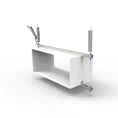


Product parameters
| Product Name: | Lateral & Longitudinal Seismic Restraint For Ductwork |
| Type: | seismic restraint for air ducts/seismic restraint system/seismic hanger assembly for ductwork/duct seismic bracing/duct seismic brace/seismic restraint for ductwork/duct two-way seismic brace/two-way seismic restraint for ductwork/bidirectional seismic brace for duct systems |
| Material: | Q235 carbon steel |
| Surface Treatment: | Galvanizing |
Other Characteristics
| Color: | Natural Color |
| Certification: | CMA/ILAC-MRA/CNAS/CE |
| Scope of application | Mechanical and electrical engineering, fire protection engineering, intelligent engineering, industrial equipment, nuclear power and other fields |
| Use cases | Residential buildings, office buildings, shopping malls, hospitals, schools, industrial plants, hotels, subways, utility tunnels, and other similar locations. |
| Non standard specifications are availabe according to customer's requirement. | |
Core Technical Features of Duct Two-Way Seismic Braces
1. Three-Dimensional Constraint Mechanism: Achieving Multi-Dimensional Displacement Control
The bidirectional seismic bracing system for ducts constructs a complete spatial protection system through an integrated lateral and longitudinal dual constraint subsystem. The lateral seismic restraint mechanism, composed of precisely calculated diagonal braces and channel steel, is specifically designed to resist horizontal seismic forces perpendicular to the duct axis; the longitudinal seismic restraint mechanism, through a dedicated limiting device, effectively suppresses expansion and contraction displacement along the duct axis. These two subsystems are not simply superimposed, but work collaboratively through three-dimensional connectors to form a "1+1>2" three-dimensional constraint effect, ensuring the stability of the duct under seismic wave impacts from any direction.
2. Dynamic Response Design: Balancing Rigidity and Flexibility Requirements
This system employs an innovative hinge mechanism and damping design, perfectly resolving the contradiction between seismic constraints and the thermal displacement of the duct under normal operating conditions. The patented hinged nodes allow free thermal expansion and contraction of the duct during non-seismic periods, but instantly transform into a rigid connection when the seismic force exceeds a set threshold, immediately activating seismic protection. Simultaneously, the built-in damping elements effectively absorb seismic energy through plastic deformation, significantly reducing the peak load transmitted to the building structure. This design concept, which combines rigidity and flexibility, ensures seismic safety without affecting the daily operation of the ventilation system, reflecting the cutting-edge wisdom of modern earthquake-resistant engineering.
Composition Structure of the Ductwork Two-Way Seismic Bracing System

Main Load-Bearing Structure
The system uses high-strength C-shaped/U-shaped channel steel (thickness ≥ 2.0 mm) as the core load-bearing frame, combined with adjustable-length seismic bracing rods (load capacity ≥ 10 kN) to form the main force-bearing system. All connection nodes use heavy-duty adapters and connecting plates with mechanical locking functions to ensure effective load transfer.

Professional Seismic Components
A two-way constraint system is formed by lateral hinged braces and longitudinal limiting mechanisms, where three-dimensional connection nodes can meet multi-directional force requirements. Duct fixing uses reinforced aluminum alloy clamps (width ≥ 50 mm), combined with EPDM rubber damping pads to form an anti-slip and shock-absorbing system, and precise positioning is achieved through an adjustment device with graduated markings.

Anchoring Force Transfer System
Different anchoring schemes are configured according to the building structure type: Concrete structures utilize post-expanded mechanical anchors (M12-M16), while steel structures are equipped with a dedicated beam clamp system. All anchoring points employ integrated expansion seats with a thickness ≥8mm to distribute loads and ensure effective transmission of seismic forces.

Dedicated Accessory System
Multi-pipe parallel-suspension transfer beams are provided to meet the needs of complex pipeline layouts. Precision adjusting screws with scales ensure installation accuracy control. The system integrates torque-indicating bolts and a visual inspection window, along with permanent steel-stamped identification plates, forming a full lifecycle quality traceability system.

Hot Tags: lateral & longitudinal seismic restraint for ductwork, China lateral & longitudinal seismic restraint for ductwork manufacturers, suppliers, factory


