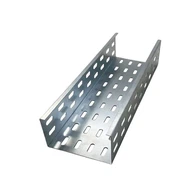


Product parameters
| Product Name: | Hot-Dip Galvanized Cable Tray |
| Type: | cable tray/channel cable tray/perforated cable tray/tray type cable tray/hot dip galvanized cable tray/hot dip cable tray/hdg cable trayhot dip galvanized perforated cable tray |
| Material: | Cold-Rolled Steel/Hot-Rolled Steel |
| Surface Treatment: | Zinc Coating |
Product Size:
| Product Size: | 50-1200mm |
| Side Rail Height: | 25-300mm |
| Length: | 2000mm,3000-6000mm or Customization |
| Thickness: | 0.6-3mm |
Steel Thickness (Recommend)
| 1.0mm-Width: | 50~100mm |
| 1.2mm--Width: | 100~150mm |
| 1.5mm--Width: | 200~500mm |
| 2.0mm--Width: | 600~700mm |
| 2.5mm--Width: | 800~1000mm |
| Customized according to customer requirements | |
Other Characteristics
| Color: | As customer requirements |
| Certification: | CMA/ILAC-MRA/CNAS/CE |
| Application: | Wiring system,cable management,electromechanical system,construction industry and so on |
| Non standard specifications are availabe according to customer's requirement | |
Hot-Dip Galvanized Cable Tray
Super Strong Anti-corrosion
Zinc layer thickness ≥ 65μm, no rust after more than 3000 hours of salt spray test, and anti-corrosion ability is 3 times that of ordinary galvanizing.
01
High-strength Load-bearing
Q235 steel is used, static load-bearing capacity reaches 500kg/m, span 6m deflection ≤1/200.
02
Economic And Durable
Maintenance-free service life of 25 years, full life cycle cost is 40% lower than stainless steel.
03
Universal Environment
Stable operation at -40℃~120℃, suitable for harsh scenes such as power plants and tunnels.
04
Specific process of hot-dip galvanizing process
Hot-dip galvanizing is a process that forms an anti-corrosion coating by reacting molten zinc liquid with steel. Its core process is as follows:
Degreasing and cleaning: Remove grease and dirt on the surface of steel (soak or spray with alkaline solution).
Acid pickling and rust removal: Soak in hydrochloric acid or sulfuric acid solution (concentration 10%-20%) to thoroughly remove oxide scale and rust.
Water washing and plating aid: After pickling, water washing neutralizes the residual acid liquid, and then immerses in zinc ammonium chloride plating aid (to prevent secondary oxidation and enhance the wettability of zinc liquid).
Drying: Dry at 100-150°C to avoid splashing of zinc liquid caused by water during zinc immersion.
Hot-dip galvanizing: Immerse the steel in molten zinc liquid (temperature 445-465°C), and zinc and iron undergo metallurgical reaction to form a zinc-iron alloy layer (about 3-5 minutes).
Cooling and passivation: Water cooling or air cooling after removal, some processes will add chromate passivation treatment (to improve corrosion resistance).
Quality inspection and finishing: Check the thickness and uniformity of the zinc layer, and repair the missed plating area (such as using zinc powder paint).
Corrosion risks and isolation measures of hot-dip galvanized trays in contact with cables
There is indeed a risk of electrochemical corrosion when hot-dip galvanized cable trays are in direct contact with aluminum cores or copper cables. This risk mainly stems from the potential difference between different metals. When there is an electrolyte (such as rainwater or condensed water), the potential difference will cause the active metal (zinc or aluminum) to act as an anode and accelerate corrosion. Among them, the combination of copper cable and hot-dip galvanized tray has the highest risk, with a potential difference of 1.10V; the potential difference between aluminum cable and zinc layer is smaller (0.15V), but it still needs protection in a humid environment.


To effectively isolate metal contact, multiple levels of protection can be taken. Physical isolation is the most direct and effective method, including the use of insulating gaskets such as nylon and rubber (≥2mm thick) to separate cables and trays, and the use of non-metallic strapping tape to fix cables. For high-risk copper cable contact situations, it is recommended to add an insulating sleeve to the outside of the cable or to treat the contact surface of the tray with epoxy resin. In engineering design, galvanic corrosion can be fundamentally avoided by selecting fully insulated cables or using alternative materials such as fiberglass/stainless steel trays.
In practical applications, special attention should be paid to the influence of environmental factors, and protection must be strengthened in humid or outdoor environments. It is recommended to construct in accordance with IEEE 835 and other standards, keep the cable laying system dry and ventilated, and establish a regular inspection system, focusing on zinc layer loss and cable insulation status. Through systematic protection design and standardized installation and maintenance, the risk of electrochemical corrosion can be effectively controlled to ensure the long-term safe operation of the cable system.

Hot Tags: hot-dip galvanized cable tray, China hot-dip galvanized cable tray manufacturers, suppliers, factory, wire support wagon, cable support wagon, cable support truck, wire support truck