


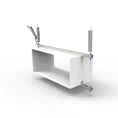


Product parameters
| Product Name: |
Lateral Seismic Restraint for Pipes |
| Type: | pipe seismic bracing/seismic restraint system/lateral seismic brace for pipes/single pipe lateral brace/single pipe two-way brace/
multi-pipe lateral brace/multi-pipe two-way brace |
| Material: | Q235 carbon steel |
| Surface Treatment: | Galvanizing |
Other Characteristics
| Color: | Natural Color |
| Certification: | CMA/ILAC-MRA/CNAS/CE |
| Scope of application | Mechanical and electrical engineering, fire protection engineering, intelligent engineering, industrial equipment, nuclear power and other fields |
| Use cases | Residential buildings, office buildings, shopping malls, hospitals, schools, industrial plants, hotels, subways, utility tunnels, and other similar locations. |
| Non standard specifications are availabe according to customer's requirement. | |
Major Components of a Lateral Seismic Bracing System for Water Pipes
This component is responsible for securely fastening the seismic bracing system to the building's primary structure, whether it be a concrete slab, wall, or structural steel beam. Common anchorage methods include high-strength "undercut mechanical anchors" or "chemical anchors" embedded in concrete, and "beam clamps" fastened to steel beams. The reliability of the anchorage points directly determines the effectiveness of the entire seismic system and serves as the starting point of the load path.
Serving as the "skeleton" of the system, these members are the core rigid components that directly withstand and transfer lateral seismic loads. They primarily include "C-channel struts" and "seismic brace rods" (or "sway braces"). The C-channel struts often function as supporting rails, while the adjustable-length seismic brace rods, with their high stiffness, are specifically designed to resist the lateral sway of the pipes, acting as the main bridge transferring forces from the pipe to the anchorage points.
This part functions to tightly connect the pipe itself to the supporting structure, typically achieved using various "pipe clamps" or "pipe rings." For insulated pipes, "insulated pipe clamps" with a larger inner diameter or special design are used to securely hold the pipe without crushing the insulation. When seismic forces act on the pipe, they are first transferred to subsequent components through this interface.
Various connectors act like the joints of the system, ensuring smooth and complete force transfer. For instance, "strut nuts" can be locked anywhere along the C-channel strut, providing flexible connection points; "3D connectors" are used to handle complex multi-directional loads; and "swivel connectors" (or "seismic hinges") allow the brace rod to pivot within a certain angle, accommodating thermal expansion and contraction while preventing undesirable bending moments during an earthquake, thus protecting other components.
This category includes smaller yet crucial parts that ensure the system's durability, safety, and functionality. For example, a "stiffener plate" is a small steel plate welded to the strut to prevent local deformation at points of high stress. A "limit stop" is a clever device that permits the pipe to move freely under normal conditions (like thermal expansion) but engages to restrict movement within a safe range if seismic displacement exceeds allowable limits.
The Design Principle and Load Transfer Path of Lateral Seismic Bracing

Design Essence: Constructing a Precise Load Transfer Path
The core function of the lateral seismic bracing system for water pipes is to establish a defined path for the transfer of seismic forces. This system forms a continuous load-transfer chain through pipe clamps, brace rods, connectors, and anchorage assemblies: seismic forces are first captured by the pipe clamps, transmitted through the seismic brace rods, transferred via connectors, and finally dissipated into the building's main structure through the anchorage components. This design ensures that seismic energy is safely transferred along a predetermined path, rather than relying on simple rigid fixation. The effectiveness of the entire system depends on the integrity of this load path, as a weakness in any single link can lead to system failure.
Design Principles: Balancing Rigid Restraint and Flexible Adaptation
The lateral seismic bracing system follows specific engineering principles to ensure its reliability. The system must guarantee that all components in the load path meet strength requirements, adhering to the "weakest link principle" to prevent any single component from failing before others. Simultaneously, the system demonstrates an exquisite balance in design-providing rigid restraint laterally to resist seismic shaking, while retaining appropriate flexibility longitudinally to accommodate thermal expansion and contraction of the pipes. This principle of combining rigidity and flexibility embodies the engineering wisdom of "managing energy" rather than merely "imposing restriction," enabling the system to ensure seismic safety without compromising the normal operational function of the pipes.


Hot Tags: lateral seismic restraint for pipes, China lateral seismic restraint for pipes manufacturers, suppliers, factory


