


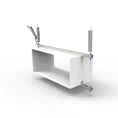


Product parameters
| Product Name: | Aluminum Cable Ladder |
| Type: | cable ladder/ladder-type cable tray/cable runway/wire cable ladder/cable support ladder/aluminum ladder cable tray/aluminum ladder tray/cable ladder manufacturer/cable ladder supports/ventilated trough cable tray |
| Material: | Aluminum Alloy |
| Surface Treatment: | Anodizing |
Product Size
| Width: | 50-1200mm |
| Side Rail Height: | 25-300mm |
| Length: | 2000mm,3000-6000mm or Customization |
| Thickness: | 0.6-3mm |
Steel Thickness (Recommend)
| 1.0mm--Width | 50~100mm |
| 1.2mm--Width | 100~150mm |
| 1.5mm--Width | 200~500mm |
| 2.0mm--Width | 600~700mm |
| 2.5mm--Width | 800~1000mm |
| As customer requirements | |
Other Characteristics
| Color: | As customer requirements |
| Certification: | CMA/ILAC-MRA/CNAS/CE |
| Application: | Wiring system,cable management,electromechanical system,construction industry and so on. |
| Non standard specifications are availabe according to customer's requirement. | |
Characteristics of aluminum cable ladders
The core characteristics of aluminum cable ladders are the combination of lightweight and excellent corrosion resistance. Its material is usually aluminum alloy (such as 6063-T5 or 6061-T6), with a density of about 1/3 of steel (about 2.7g/cm³). Under the same specifications, the weight is more than 50% lighter than that of steel ladders, which not only reduces the labor cost during transportation and installation (one person can easily carry it), but also reduces the load-bearing requirements of the bracket, which is especially suitable for scenes that are sensitive to load-bearing, such as high altitude or roof.
At the same time, the oxide film (Al₂O₃) naturally formed on the surface of aluminum alloy has self-passivation characteristics. In humid, weak acid and weak alkali or mild salt spray environments (such as outdoor humid areas, general industrial plants), it can be used for a long time without additional anti-corrosion coating, avoiding the maintenance cost of regular painting of steel ladders for anti-corrosion. For example, in coastal areas, the corrosion resistance life of aluminum ladders can reach more than 20 years, far exceeding that of steel ladders without special anti-corrosion treatment (5-8 years). In addition, aluminum alloy has good thermal conductivity (about 205W/m·K). In scenarios where cable heat dissipation requirements are high, it can dissipate heat faster, reduce cable operating temperature, and improve safety.


Application scenarios of aluminum cable ladders
Aluminum cable ladders perform well in outdoor open-air environments. Due to long-term exposure to rain, ultraviolet rays and temperature changes, this environment has extremely high requirements for the weather resistance and lightweight of the equipment. The aluminum cable ladder can effectively resist outdoor moisture and acid rain erosion with the oxide film naturally formed on the surface of the aluminum alloy, and does not require frequent anti-corrosion maintenance; at the same time, its light weight is convenient for high-altitude installation. For example, when used in scenes such as street light cable bridges and outdoor substations, it can significantly reduce the bracket load, making it an ideal choice for laying cables in urban outdoor power pipelines and wind farms.
Humid and corrosive environments, such as high humidity scenes such as basements and tunnels, and places such as sewage treatment plants that are exposed to weak acids and weak alkalis, have strict requirements on the corrosion resistance of cable ladders. The natural corrosion resistance of aluminum cable ladders far exceeds that of carbon steel, which can avoid the problem of structural damage caused by rust. Taking underground pipe corridors as an example, the use of aluminum cable ladders can reduce the risk of leakage caused by moisture, and its maintenance cycle can be extended to 5-8 years. In contrast, steel cable ladders only need to be treated with anti-corrosion every 2-3 years.
Aluminum cable ladders play an important role in scenarios with high load-bearing capacity but light weight, such as industrial plant equipment layers and multi-layer cable wells. These scenarios require cable ladders to be able to carry dense cables while reducing building loads. The strength of aluminum alloy is close to that of low-carbon steel, with a tensile strength of 200-300MPa and a lighter weight. For example, a ladder with a span of 2 meters is 12-15kg lighter than steel, which is more suitable for buildings with limited floor load-bearing capacity, effectively balancing the load-bearing requirements and building structure pressure.
For inflammable and explosive hazardous areas such as chemical workshops and oil depots, safety is the primary consideration, and cable ladders are required to have anti-static and spark-avoiding properties. The aluminum alloy used in the aluminum cable ladder is a non-magnetic material, which will not generate eddy current heating due to electromagnetic induction; and it is not easy to generate sparks during friction and collision, which can strictly meet the explosion-proof environment specifications, such as ATEX certification requirements, and provide reliable safety guarantees for cable laying in hazardous areas.
The rail transit and shipbuilding fields have special needs for cable ladders. The cable ladders are required to be lightweight and salt spray resistant in scenes such as the bottom of train carriages and cable channels in cabins. Aluminum cable ladders have been widely used in these fields. For example, in the laying of cables in subway tunnels, their lightweight characteristics can reduce the overall weight of the train; when used in ship deck cable bridges, they can resist marine salt spray corrosion. Data shows that the annual corrosion rate of aluminum alloy in seawater is only 0.05mm, which is much lower than the 0.5mm of carbon steel, and has a longer service life.
In temporary projects that require rapid installation, such as temporary construction sites and exhibition power layout, aluminum cable ladders stand out with their own advantages. Such scenarios require that the equipment can be easily disassembled and assembled. The aluminum cable ladder adopts a modular design, is light in weight and has flexible connection methods. Both bolt connection and snap connection are very simple, and the installation efficiency is more than 30% higher than that of the steel ladder frame. After the project is completed and disassembled, the aluminum cable ladder can be reused to reduce costs
How to choose the appropriate specifications of aluminum cable ladder?
Choosing the appropriate specifications of aluminum cable ladders requires comprehensive consideration from multiple dimensions. First, the cable load must be accurately calculated, and the width and height of the ladder frame must be determined according to the number, diameter, and laying method of the cables, while 30% of the heat dissipation space must be reserved; then, according to the installation span and load-bearing weight, aluminum alloy materials of different strength grades such as 6063-T5 or 6061-T6 must be matched, and the appropriate thickness of the ladder frame must be selected accordingly. In addition, environmental adaptability is also crucial. Outdoor or corrosive scenes require consideration of protective processes such as anodizing and fluorocarbon spraying, while indoor dry environments can choose basic protection to reduce costs; at the same time, factors such as installation methods, space limitations, and industry standard certification must also be included in the selection range.
In the specific selection process, giving priority to standard specifications can save costs and delivery cycles, and non-standard requirements can be optimized through segmented splicing. In actual operation, it is recommended to calculate the basic specifications after counting the cable parameters, select the protection process based on the installation environment, and then select the model according to the installation space and industry standards. Finally, compare the technical parameters such as the load-bearing-span curve provided by the manufacturer for review. If necessary, entrust a professional organization to calculate to ensure that the safe bearing capacity of the selected aluminum cable ladder reaches more than 1.5 times the rated load.

Hot Tags: aluminum cable ladder, China aluminum cable ladder manufacturers, suppliers, factory, wire support wagon, cable support wagon, cable support truck, wire support truck


