


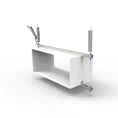
To judge the quality of a cable tray, the first thing to consider is the base material, which is crucial for determining its load-bearing capacity and corrosion resistance. High-quality cable trays will clearly indicate the base material type, such as "Q235 cold-rolled steel plate" or "hot-dip galvanized steel plate" for steel cable trays, or "6063/6061 series aluminum alloy" for aluminum cable trays. Polymer cable trays (such as FRP) have a smooth, delamination-free surface. Low-quality cable trays may be made of recycled steel, low-grade aluminum, or polymer materials mixed with recycled materials. These surfaces are prone to pitting and impurities, and polymer cable trays can sound muffled when tapped. Also, use a caliper to measure the base material thickness to ensure compliance with industry standards. For example, for a 100mm wide steel trough cable tray, the base plate thickness should be ≥1.0mm and the side plates ≥1.2mm. Low-quality products often have a thickness of 0.2-0.3mm less, significantly reducing the load-bearing capacity.
Secondly, check the surface treatment process, which directly affects the cable tray's corrosion resistance and service life. The spray-coated and fire-retardant coatings on steel or aluminum cable trays must be evenly applied without gaps, leaving no marks when scratched with a fingernail or fading when wiped with a damp cloth. Inferior coatings are prone to pinholes, sagging, and even incomplete curing. The hot-dip galvanizing layer should be ≥85μm thick, with a uniform silver-gray surface and no zinc nodules. Inferior zinc coatings are thin and prone to flaking. The anodized layer on aluminum cable trays should be ≥10μm thick and free of whitening or smearing. Inferior oxide coatings can easily reveal the base after friction. The surface of polymer cable trays must be free of bubbles, cracks, and burrs. Inferior products may have edge flash and chipped corners due to poor mold precision, which can affect the sealing of joints.
Structural strength and stability can also be assessed through simple testing to prevent deformation during use. For example, a 1-meter-long cable tray is erected at both ends, with a weight equivalent to the rated load placed in the middle. After standing for 1 hour, a high-quality cable tray will exhibit a deflection of ≤L/200 (L is the span), with no noticeable sagging. Inferior cable trays will exhibit bending and side panel deformation. Use matching connectors to connect two cable tray sections. High-quality cable trays should have gaps ≤0.5mm and no looseness even when shaken. Low-quality cable trays may have misaligned bolt holes and larger gaps. Also, observe the edge workmanship. High-quality cable trays often have rounded corners or fully welded surfaces, free of sharp burrs. Low-quality products may have sharp right-angled edges and weld slag, which can easily scratch cables.
Also, verify performance indicators and compliance, and reject "three-no" products. Reputable cable trays will provide complete test reports. Fire-resistant cable trays must have a GB/T 14907-2018 test report, clearly stating the fire resistance limit and a traceable serial number. Anti-corrosion cable trays must have a salt spray test report (neutral salt spray for ≥48 hours, no rust); and polymer cable trays must have an aging test report (UV aging for ≥1000 hours, no cracking). High-quality cable trays will also have the manufacturer's name, model, specifications, and production date clearly marked on the surface. Manufacturers should also provide business licenses and other qualifications. Products without "three-no" labels, manufacturer information, or reports should be avoided. Finally, the quality of accessories cannot be overlooked; details determine overall reliability. High-quality connectors (bolts and nuts) are galvanized or stainless steel, with clear, smooth threads. Low-quality accessories are often made of unprotected black iron, with rough threads prone to slippage. High-quality covers fit tightly to the cable tray, with no warping at the edges, and snap-on covers with good elasticity. Low-quality covers are thin, have large gaps, and are prone to brittle breakage. The dedicated grounding wire for steel or aluminum cable trays should have a cross-sectional area ≥4mm², be insulated, and have securely crimped terminals. Low-quality products may use thin wire as a substitute, resulting in loose terminals that affect grounding effectiveness.