


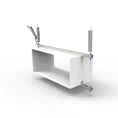
The selection of parameters for water pipe seismic brackets directly impacts their adaptability and safety. Core parameters revolve around three key dimensions: load-bearing capacity, compatible pipes, and installation environment. These parameters collectively determine bracket selection and performance. In terms of core performance parameters, maximum lateral and longitudinal bearing capacities are key. The former refers to the maximum horizontal lateral tension or compression that the bracket can withstand, typically expressed in kN. For example, the lateral bearing capacity of a common DN100 water pipe bracket is typically between 5kN and 12kN. The latter, referring to the longitudinal seismic support, is generally smaller than the lateral bearing capacity, typically between 3kN and 8kN. Both must be calculated based on the weight of the pipe filled with water and the seismic acceleration. The seismic fortification intensity must be clearly defined. The mainstream domestic standards are 6, 7, 8, and 9 degrees. This must be consistent with the seismic fortification intensity of the buildings in the project area and cannot be used across levels. Load types are divided into static loads (pipeline weight + medium weight) and dynamic loads (earthquake impact). The parameter table will indicate the safety factors for both loads, typically requiring a safety factor of 1.5 or higher.
The compatible pipe parameters are the basis for bracket selection and determine whether it is compatible with the on-site water pipes. The compatible pipe diameter range is indicated by DN (nominal diameter) or outer diameter (e.g., Φ), for example, "Adapts DN50-DN200." This covers common fire protection and water pipe sizes. Ensure that the actual pipe diameter falls within this range. Pipe material compatibility is indicated by the applicable material, such as steel-plastic pipe, galvanized steel pipe, or stainless steel pipe. Pipes of different materials have different outer diameters and weights, which can affect the clamping force. The maximum allowable pipe weight is the maximum weight of a single pipe section (including the medium) that the bracket can support. The unit is kg or kN. For example, "Maximum support weight 50kg" requires calculating the weight of a single section based on the pipe length and medium density to avoid overloading.
Structural and installation parameters affect bracket installation feasibility and on-site compatibility. Bracket materials commonly used are Q235B carbon steel (hot-dip galvanized) and 304 stainless steel. The choice should be based on environmental corrosion. Profile specifications, such as "C-shaped steel 150×50×2.5mm" (width × height × thickness), typically have a thickness of 2.5mm-4mm, which directly affects load-bearing capacity. Regarding installation spacing, the spacing between lateral braces in the same direction on horizontal pipes is typically no more than 18m (up to 24m for pipes under DN65), and the spacing between longitudinal braces is typically no more than 36m. Reference should be made to the "Code for Seismic Design of Mechanical and Electrical Engineering for Buildings" (GB 50981). Regarding installation angles, the angle between lateral braces and horizontal pipes is typically 45° or 60°, while the angle between longitudinal braces is typically 30° or 45°. The data sheet will clearly indicate recommended angles to ensure optimal load bearing.
Environmental and protective parameters impact bracket durability. In terms of corrosion resistance, hot-dip galvanizing (HDG) with a zinc layer thickness of ≥85μm is suitable for humid, slightly corrosive environments (such as basements and bathrooms). Electroplating (EZ) with a zinc layer thickness of ≥12μm is suitable for dry indoor environments. 304 stainless steel is suitable for moderately corrosive environments, and 316 stainless steel is suitable for highly corrosive environments (such as chemical workshops and seaside). The operating temperature range is usually marked as -20°C to 80°C. Special scenarios (such as high-temperature hot water pipes) require the selection of brackets with higher temperature resistance to ensure that rubber pads and connectors do not fail. For a more intuitive comparison, the reference parameters of the brackets for common pipe diameters are as follows: brackets suitable for pipe diameters of DN65-100, made of Q235B hot-dip galvanized steel, have a lateral bearing capacity of 5-8kN, a longitudinal bearing capacity of 3-5kN, are suitable for a fortification intensity of 6-8 degrees, and are recommended for installation spacing of 12-18m; brackets suitable for pipe diameters of DN125-150, made of Q235B hot-dip galvanized steel, have a lateral bearing capacity of 8-12kN, a longitudinal bearing capacity of 5-7kN, are suitable for a fortification intensity of 6-9 degrees, and are recommended for installation spacing of 10-15m; brackets suitable for pipe diameters of DN200-250, made of 304 stainless steel, have a lateral bearing capacity of 12-15kN, a longitudinal bearing capacity of 7-10kN, are suitable for a fortification intensity of 7-9 degrees, and are recommended for installation spacing of 8-12m.