


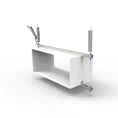


Product parameters
| Product Name: | Fiberglass Reinforced Plastic Cable Trough |
| Type: | cable trunking/cable duct/cable raceway/cable channel/wireway/cable trough/frp tray manufacturer/frp trunking/perforated frp cable tray/frp cable tray support/frp cable tray supplier |
| Material: | Fiberglass/Resin |
| Surface Treatment: | Gel Coat/Surface Coating/Polishing/Flame Retardant Treatment |
Product Size
| Width: | 50-1200mm |
| Side Rail Height: | 25-300mm |
| Length: | 2000mm,3000-6000mm or Customization |
| Thickness: | 0.6-3mm |
Steel Thickness (Recommend)
| 1.0mm-Width: | 50~100mm |
| 1.2mm-Width: | 100~150mm |
| 1.5mm--Width: | 200~500mm |
| 2.0mm--Width: | 600~700mm |
| 2.5mm--Width: | 800~1000mm |
| As customer requirements | |
Other Characteristics
| Color: | As customer requirements |
| Certification: | CMA/ILAC-MRA/CNAS/CE |
| Application: | Wiring system,cable management,electromechanical system,construction industry and so on. |
| Non standard specifications are availabe according to customer's requirement. | |
Advantages of polymer cable trunking
Lightweight And High Strength
Density is only 1/4 of steel, compressive
strength ≥180MPa, installation efficiency
increased by 50%.
Super Corrosion Resistance
Resistant to acid, alkali and salt spray,
service life in chemical environment up
to 25 years (measured salt spray 6000h
without corrosion).

Insulation And Flame Retardant
Breakdown voltage ≥22kVimm, oxygen
index 232, passed UL94 V0 fireproof
certification.
Anti-seismic And Anti-aging
Stable operation at -60℃~150℃, anti-UV
performance makes outdoor life more
than 20 years.
Effect of fiber ratio on mechanical strength of FRP cable tray

There is a close correlation between the fiber reinforcement ratio of FRP cable trough and its mechanical strength, which directly affects the engineering applicability of the product. In a typical formula, glass fiber is used as the core reinforcement material, and its content usually fluctuates between 30% and 70%, and this ratio change will significantly change the mechanical performance of the material. When the fiber weight ratio reaches the golden range of 50%-55%, the cable trough can achieve the best strength-toughness balance, the tensile strength can reach 300-350MPa, and the bending modulus is maintained at 15-18GPa, which fully meets the mechanical requirements of most power projects for cable support systems. It is worth noting that the higher the fiber ratio, the better. Once it exceeds the critical value of 65%, the resin matrix is difficult to completely infiltrate the fiber, but will lead to a decrease in interfacial bonding and a reduction in impact strength of about 20%.
In actual production, different processes have obvious differences in their ability to control fiber content. Traditional hand lay-up processes can usually only achieve a fiber content of less than 45%, and the strength fluctuates greatly; while advanced pultrusion technology can accurately control the fiber ratio at around 60%, increasing the axial strength of the product by more than 40%. For special application scenarios, engineers will adopt targeted optimization strategies: in corrosive environments such as chemical zones, the combination of 60% fiber and vinyl ester resin can increase acid and alkali resistance by 3 times; in situations where impact resistance is required, 5%-10% of short-cut fibers are added to enhance toughness. The State Grid Q/GDW 1819-2013 standard clearly requires that the fiber content of power cable troughs must not be less than 50%, and some offshore wind power projects use a 55% fiber mixed with carbon fiber solution to increase the product's typhoon resistance by 60%.


To ensure product quality, the industry generally uses the burn-out method (GB/T 2577) to accurately determine the fiber content, and cooperates with the three-point bending test (ASTM D790) to verify the actual strength. Electron microscope scanning analysis shows that when the fiber content is appropriate, the fracture surface presents a mixed morphology of fiber pull-out and resin fracture, indicating that the stress has been effectively transmitted and dispersed. From an economic point of view, every 5% increase in fiber content will increase material costs by 8%-10%, so it is necessary to select the right type according to the JC/T 941-2016 standard: 40%-45% for light load scenarios (Class I), 45%-55% for medium loads (Class II), and 55%-60% for heavy loads (Class III). Through this precise control, high-quality FRP cable troughs can achieve a strength-to-weight ratio that is more than three times that of galvanized steel, while maintaining excellent corrosion resistance, which is the fundamental reason why they are increasingly replacing traditional metal products in the fields of electricity, chemical industry, etc.
Long-term stability and anti-loosening solution for modular connection of FRP cable trough
The modular connection method of FRP cable trough combines the dual advantages of convenient installation and long-term stability. Let's learn how these innovative designs ensure long-term reliable use.
There are two main mainstream connection solutions: one is the classic bolt splicing system, and the other is the convenient snap-on connection. The bolt connection uses durable 304 stainless steel material, with special elastic gaskets, and through scientific preload design, it is like putting a "safety lock" on the connection part. What's more clever is that the self-locking thread characteristics of the FRP material itself allow this connection to remain stable even in a vibrating environment. Actual engineering data is very convincing: in a subway project, a test after ten years of use showed that this bolt node still maintained more than 85% of its initial strength.
Another snap-on connection demonstrates the wisdom of engineering design. The unique "double hook lock" structure is like two tightly clasped hands. It can not only withstand a tensile force of more than 500N, but also thoughtfully reserves 1-2mm of expansion space, allowing the connection part to "breathe" freely with temperature changes. This design not only ensures stability, but also avoids stress problems caused by thermal expansion and contraction.
For different use environments, engineers have also developed special "anti-loosening secrets":
- On bridges with heavy traffic, nylon locking nuts are used, just like putting a "safety helmet" on the bolts;
- In chemical plants, special thread glue is used, which can resist corrosion and facilitate future maintenance;
- The elastic retainer installed at the snap-on connection directly increases the vibration resistance by 3 times.
These designs have been rigorously tested in practice. For example, in a certain offshore wind power plant, a connection system with a triple anti-loosening design has been used. Under the erosion of the sea breeze of humid salt spray, it has maintained an excellent working condition for 8 years.
When choosing a connection method, you can match it according to specific needs:
- Bolt connection is recommended for heavy load occasions, and it is best to choose a reinforced version with a metal bushing;
- When quick installation is required, the snap-on type with a self-checking prompt sound is the best choice;
- In special environments, it is necessary to confirm that the product has passed the anti-loosening test of international standards such as DIN.
Through such careful design, the connection system of modern FRP cable trough is fully capable of accompanying the trough body through its 20-year service life, providing long-lasting and reliable support for various engineering projects.
Hot Tags: fiberglass reinforced plastic cable trough, China fiberglass reinforced plastic cable trough manufacturers, suppliers, factory, wire support wagon, cable support truck, cable support wagon, wire support truck


