


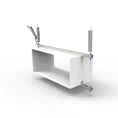
The zinc aluminum magnesium cable tray, with its core advantages of "dual anti-corrosion (sacrificial anode+dense passivation film)+local self-healing", can withstand various high corrosion and high humidity special industrial environments, especially suitable for scenarios where traditional cable tray structures are prone to failure, as follows:
This type of environment contains high concentrations of chloride ions (such as coastal port machinery factories, marine engineering equipment factories, and port chemical industrial parks), and salt spray can quickly erode traditional galvanized coatings. The dense passivation film generated by the zinc aluminum magnesium coating can block the penetration of chloride ions, and can self repair after scratching, avoiding "rust point diffusion" and ensuring 8-15 years of no obvious corrosion. It has a lifespan 2-3 times longer than traditional hot-dip galvanized cable tray frames and does not require frequent application of anti-corrosion paint.
In scenarios such as fertilizer plants (containing ammonia and nitric acid media), dye plants (containing acidic dye waste liquids), and electroplating workshops (containing volatile compounds from chrome plating and zinc plating wastewater), splashing of acidic or alkaline gases or liquids can accelerate metal corrosion. The composite passivation film of zinc aluminum magnesium coating has much better acid and alkali stability than pure zinc layer, and can resist acid and alkali erosion in the pH range of 3-11. It can withstand mild acid and alkali fog for a long time, avoiding the problems of coating peeling and substrate corrosion that occur in traditional cable trays 1-3 years.
The environmental humidity in food processing (such as seafood processing and meat pickling workshops) and pharmaceutical factories (such as sterile water preparation rooms and liquid cleaning areas) is often maintained above 85%, and there may be residual salt water and cleaning agents. High humidity can easily lead to the formation of loose rust on the zinc layer of traditional cable tray frames, polluting the production environment of food or medicine. The passivation film of zinc aluminum magnesium bridge has strong waterproof properties, and the surface is not easy to condense water vapor. The coating does not release harmful substances, which meets the hygiene requirements of food grade and pharmaceutical grade environments. At the same time, it can avoid damage to the bridge structure caused by moisture.
In the mining beneficiation workshop (including mineral powder dust and flushing water) and the steel plant cold rolling workshop (including emulsion volatiles and cooling water mist), dust is prone to adhere to the surface of the cable tray, combine with humid air to form a "corrosive slurry", and penetrate the small gaps of the traditional galvanized layer. The zinc aluminum magnesium coating has higher hardness (20% higher than pure zinc), can resist dust wear, and the dense film layer can prevent slurry penetration. Even if exposed for a long time, it is not easy to cause "dust wrapped corrosion", reducing the risk of cable short circuit caused by cable tray corrosion.
In scenarios such as photovoltaic power plants (outdoor support cable tray frames) and highway charging piles (outdoor wiring bridge frames), the bridge frames need to withstand long-term exposure to sunlight, rain, and temperature differences between day and night. Traditional galvanized layers are prone to cracking due to thermal expansion and contraction, leading to water ingress and corrosion. The zinc aluminum magnesium coating has better ductility and adhesion, can adapt to substrate deformation caused by temperature fluctuations, and the passivation film is resistant to ultraviolet aging. It can maintain a service life of 10-18 years for outdoor use, without the need for rust removal and paint repair maintenance every 3-5 years like traditional bridge frames.