


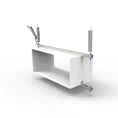
Modular structure drives efficient wiring, and installation efficiency and space utilization are both improved.
The cable tray is based on a standardized trough, ladder or grid structure, and supports flexible combination according to the cable type. The open layout realizes the layered and orderly arrangement of power, control and communication cables. The hollow bottom plate or side opening design can increase the cable heat dissipation efficiency in scenarios such as data centers by more than 25%. Modular components support rapid on-site assembly, reducing installation hours by more than 30% compared to traditional pipe laying. The installation time of a single set of 600×200mm cable trays can be compressed from 6 hours to 2 hours, greatly reducing construction costs and cycles, and increasing space utilization by 40% compared to traditional methods.
Multi-dimensional protection design builds long-term durability, and convenient maintenance subverts traditional wiring.
The material and structural design of the bridge give it strong environmental adaptability: the steel bridge is hot-dip galvanized (zinc layer ≥ 85μm) and can withstand salt spray corrosion for more than 1,000 hours. The anodized film of the aluminum alloy bridge (oxidation layer ≥ 10μm) has a service life of more than 30 years in coastal areas. The fire-resistant bridge (fire resistance limit ≥ 120 minutes) meets the continuous power supply needs of fire-fighting cables. The open structure allows operation and maintenance personnel to directly inspect the cable status. When replacing a single cable, there is no need to disassemble the system, and the maintenance efficiency is increased by 60%. Compared with the traditional pipe-threading method, the maintenance cost is greatly reduced. The hot-dip galvanizing and fire-resistant properties have passed the GB 50168 and other specifications.
Full-scenario adaptability activates multiple application values, and the full life cycle cost is significantly optimized
In the industrial field, galvanized bridges with dust cover plates are suitable for dust workshops, and 304 stainless steel bridges resist chemical corrosion and meet the aseptic wiring requirements of clean areas in pharmaceutical factories; in commercial buildings, the weight of aluminum alloy bridges is only 1/3 of that of steel bridges, and the ultra-long design of a single span of 6 meters is suitable for large-span spaces such as shopping malls; data centers rely on the ventilation characteristics of grid bridges and cooperate with temperature control systems to control cable temperature at ≤40℃. Industry data shows that the full life cycle cost of bridge wiring systems is 25%-35% lower than that of traditional methods, and the dual value of "efficient wiring + long-term protection" is achieved from industrial dust environments to high-density scenarios in data centers.

