


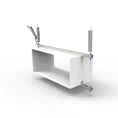


Product parameters
| Product Name: | Polymer Cable Ladder |
| Type: | cable ladder/ladder-type cable tray/cable runway/wire cable ladder/cable support ladder/ladder tray/ladder cable tray/cable ladder rack/ladder rack cable tray |
| Material: | PVC/PP/PE |
| Surface Treatment: | Surface Coating/UV-Cured Coating/Plasma Treatment/Corona Treatment/Polishing/Flame Retardant Treatment |
Product Size
| Width: | 50-1200mm |
| Side Rail Height: | 25-300mm |
| Length: | 2000mm,3000-6000mm or Customization |
| Thickness: | 0.6-3mm |
Steel Thickness (Recommend)
| 1.0mm--Width | 50~100mm |
| 1.2mm--Width | 100~150mm |
| 1.5mm--Width | 200~500mm |
| 2.0mm--Width | 600~700mm |
| 2.5mm--Width | 800~1000mm |
| As customer requirements | |
Other Characteristics
| Color: | As customer requirements |
| Certification: | CMA/ILAC-MRA/CNAS/CE |
| Application: | Wiring system,cable management,electromechanical system,construction industry and so on. |
| Non standard specifications are availabe according to customer's requirement. | |

Advantages of polymer cable ladder
The polymer cable ladder stands out for its unique advantages. With its highly corrosion-resistant polymer material, it is not afraid of harsh environments such as acid, alkali, salt spray, and is not easy to rust and age; it has excellent insulation performance, avoids the risk of leakage, and does not require additional insulation treatment; it is light, only about one-third of the metal cable ladder, and installation and transportation are time-saving and labor-saving; at the same time, it has good impact resistance and anti-electromagnetic interference capabilities, which can protect the stable operation of the cable, and has low maintenance costs, long service life, and can be recycled. It is both practical and environmentally friendly, and has broad application prospects in chemical, electric power, communications and other fields.
Choosing a suitable cable ladder requires a comprehensive consideration of many factors: first, based on the use environment, for example, in highly corrosive scenes such as chemical and coastal areas, acid- and alkali-resistant polymer cable ladders are preferred, while steel or aluminum alloy materials can be considered for ordinary dry environments; second, the load requirements must be clearly defined, and the load-bearing capacity of the bridge frame must be calculated based on the number and weight of cables to ensure that the load capacity of the ladder structure matches (such as the rated uniformly distributed load must be greater than the actual cable weight); third, the installation space and cable type must be considered, and appropriate specifications (such as ladder width and height) must be selected based on the diameter and number of laid cables. Signal cables must pay attention to their anti-electromagnetic interference performance, and non-magnetic polymer materials can be selected; in addition, attention must also be paid to fire resistance (such as flame retardant requirements), weather resistance (anti-ultraviolet rays are required outdoors) and maintenance costs. Polymer materials do not require anti-corrosion treatment and have a long lifespan, while metal materials require anti-rust measures. Finally, the initial purchase cost and long-term use benefits must be weighed against the budget to select a cost-effective solution.

The difference in load capacity between polymer cable ladder and metal cable ladder
Material properties
The tensile and bending strength of polymer materials are lower than that of metals, and the elastic modulus is only 1/20-1/10 of that of steel, but the density is small.
01
Carrying capacity
Under the same specifications, the uniform load of polymer cable ladder is usually 40-120kg/m, and the metal bridge can reach 150-250kg/m; in terms of concentrated load, polymer allows 15-50kg, and metal can reach 50-80kg.
02
Influencing factors
Polymer materials are sensitive to temperature and humidity, and there is creep phenomenon, which requires a larger safety factor; metal bridge structure is more solid and has strong bending resistance.
03
Applicable scenarios
Polymer is suitable for light load and communication cable scenarios; metal bridge is used for heavy load, large span and dynamic load environment.
04


Hot Tags: polymer cable ladder, China polymer cable ladder manufacturers, suppliers, factory, wire support truck, wire support wagon, cable support wagon, cable support truck


