


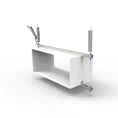
The standard requirements for bridge grounding wires mainly include the material, connection method, number and location of grounding points.
Material and connection method: The copper core grounding wire should be connected across both ends of the connecting plate between non-galvanized cable bridges, and the minimum allowable cross-section shall not be less than 4 square millimeters. The grounding wire may not be connected across both ends of the connecting plate between galvanized cable bridges, but it must be fixed with no less than 2 bolts with anti-loosening nuts or anti-loosening washers.
Number and location of grounding points: The entire length of the cable bridge should be connected to the grounding (PE) trunk line at least 2 points. If the total length is greater than 30m, the connection points with the grounding grid should be increased every 20 to 30m. The starting and ending ends of the cable bridge should be reliably connected to the grounding grid.
Implementation details: The cross-sectional area of the grounding wire should meet the requirements and be no less than 4mm², and the direction should be straight and the angle at the bend should be beautiful. The two ends of the connecting plate between the non-galvanized metal bridge, tray and trough box body should be connected across the protective bonding conductor, and the specification of the protective bonding conductor should be no less than 4mm² copper core wire.
These standards ensure electrical safety and prevent electrical accidents, and are important safety measures in the field of electrical engineering and construction.