


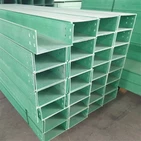
The weak current system of intelligent buildings usually consists of multiple information monitoring and communication facilities such as BA (building automation), OA (office automation), CA (communication automation) and other corresponding systems. Taking BA as an example, in addition to the necessary information monitoring of the building's power supply, water supply and drainage, air conditioning, elevators and parking facilities, there are also several subsystems such as SA (security automation) and FA (fire automation) to achieve system integration or partial system integration. The level and content are determined according to the functional requirements of the main building. These systems include different types of cables and wires, some of which are active cables (the power supply voltage is generally DC12/24/48V and AC220V). Due to the continuous development of the construction industry, cable trays are also keeping pace with the times and are constantly recognized and accepted by the market. The localization efforts of the cable tray industry, the product uses high-quality cold-rolled steel plates, which have received widespread attention. The product uses high-quality cold-rolled steel plates, and the surface processes include cold galvanizing, hot galvanizing, electrostatic spraying, fire retardant coatings, and baking varnishes. Among them, the products are widely used in petrochemical, metallurgy, electricity, school communications, high-rise buildings and other fields, with beautiful appearance, strong corrosion resistance, wide versatility, flexible and convenient installation, and complete varieties.
Some are passive electrical (optical) cables (such as data cables, video coaxial cables, etc.). Therefore, when designing the arrangement of wiring methods and routing selection, they should be distinguished. Not only should they meet the requirements of the specifications, but also the safety, scalability, economy and beauty of the wiring should be considered, and it is easy to maintain. The cable tray, as a carrier for laying various cables, is subordinate to the needs of wiring and should also be implemented in accordance with the above principles. Due to the parallel crossing of multiple pipelines in buildings and limited space, especially in large office buildings, financial commercial buildings, hotels, venues and other buildings with dense information points, in addition to the use of floor grooves and buried pipes in the wall, cable bridges are widely used in shafts and indoor ceilings to provide wiring in different directions. Various cables of weak current systems are classified and laid in the bridge. The best route selection and installation method should be determined according to the requirements of the direction and in combination with the building structure and the negotiated positions of air conditioning, electrical and other pipelines. Passive cables cannot be laid side by side with active cables. They must be laid in the same bridge due to limited conditions. Metal partitions must be used to separate them. The cables drawn out should avoid plane crossing as much as possible. When the bridge passes through the floor, wall or expansion joint, the corresponding holes and positions should be marked on the building drawings to avoid temporary drilling during construction due to omissions, which may damage the civil structure. In order to prevent interference from electromagnetic radiation (EMC), the closedness of the bridge should be considered in the design of the bridge.
Cable Tray Design
Jun 03, 2024 Leave a message
Previous
Cable Tray LoadSend Inquiry