


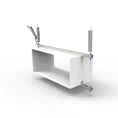


Polymer cable trays are widely used in various industries for cable management due to their excellent properties such as corrosion resistance, lightweight, and ease of installation. As a supplier of polymer cable trays, understanding the chemical composition of these products is crucial. In this blog, we will delve into the chemical makeup of polymer cable trays, exploring the key components and their functions.
1. Base Polymers
The foundation of polymer cable trays lies in the base polymers used. These polymers form the bulk of the material and largely determine the basic properties of the cable trays.

Polyvinyl Chloride (PVC)
PVC is a commonly used base polymer in polymer cable trays. It is a thermoplastic polymer known for its high chemical resistance, especially against acids, alkalis, and many organic solvents. This makes PVC - based cable trays suitable for use in harsh chemical environments, such as chemical plants and wastewater treatment facilities.
PVC also has good flame - retardant properties. By adding appropriate flame - retardant additives, PVC cable trays can meet strict fire safety standards. However, PVC has some limitations. It has relatively poor heat resistance compared to some other polymers, and at high temperatures, it may release harmful substances such as hydrogen chloride gas.
Polypropylene (PP)
PP is another popular choice for polymer cable trays. It is a lightweight and tough polymer with excellent chemical resistance, especially to non - polar solvents. PP has a high melting point, which gives it better heat resistance than PVC. This makes PP - based cable trays suitable for applications where higher temperatures are expected, such as in power generation plants near heat sources.
PP is also known for its good impact resistance, which means the cable trays can withstand mechanical shocks during installation and operation. However, PP is more prone to oxidation and UV degradation, so proper additives are usually required to enhance its weatherability.
Fiberglass - Reinforced Polymers (FRP)
FRP combines a polymer matrix with fiberglass reinforcement. The polymer matrix can be epoxy, polyester, or vinyl ester resin. Fiberglass provides high strength and stiffness to the cable trays. It can significantly improve the load - bearing capacity of the trays, allowing them to support a large number of cables.
Epoxy - based FRP cable trays offer excellent chemical resistance and adhesion. They are often used in applications where high corrosion resistance is needed, such as in marine environments. Polyester - based FRP is more cost - effective and has good mechanical properties. Vinyl ester - based FRP combines the best properties of epoxy and polyester, offering high corrosion resistance and good mechanical performance.
2. Additives
Additives are used in polymer cable trays to enhance specific properties or to overcome the limitations of the base polymers.
Flame Retardants
Flame retardants are essential additives in polymer cable trays, especially in applications where fire safety is a major concern. There are several types of flame retardants, including halogen - based and halogen - free flame retardants.
Halogen - based flame retardants, such as brominated and chlorinated compounds, are very effective in reducing the flammability of polymers. They work by releasing halogen radicals during combustion, which react with the free radicals in the flame and interrupt the combustion process. However, halogen - based flame retardants have some environmental and health concerns, as they may release toxic and corrosive gases during a fire.

Halogen - free flame retardants, such as metal hydroxides (e.g., aluminum hydroxide and magnesium hydroxide), are becoming more popular due to their environmental friendliness. They work by releasing water vapor when heated, which cools the flame and dilutes the combustible gases.
UV Stabilizers
UV stabilizers are used to protect the polymer cable trays from the damaging effects of ultraviolet radiation. When exposed to sunlight, polymers can undergo degradation, which leads to a loss of mechanical properties, color change, and surface cracking.
There are two main types of UV stabilizers: absorbers and quenchers. UV absorbers work by absorbing the UV radiation and converting it into heat, which is then dissipated. Quenchers work by deactivating the excited molecules formed by UV radiation, preventing them from causing chemical reactions that lead to degradation.
Plasticizers
Plasticizers are used to increase the flexibility and processability of polymers. In PVC - based cable trays, plasticizers are added to make the material more pliable and easier to form into different shapes.
However, the use of plasticizers has some drawbacks. Over time, plasticizers can migrate out of the polymer matrix, which may lead to a loss of flexibility and an increase in the stiffness of the cable trays. Additionally, some plasticizers have been associated with environmental and health risks.
3. Types of Polymer Cable Trays and Their Chemical Composition
Different types of polymer cable trays may have slightly different chemical compositions based on their specific design and application requirements.
Polymer Tray Type Cable Tray
The polymer tray type cable tray is a simple and commonly used design. It usually has a flat bottom and low sidewalls. The chemical composition of this type of cable tray is often based on PVC or PP. For applications in indoor environments with normal chemical exposure, PVC with appropriate additives for flame retardancy and UV protection may be used. In outdoor or high - temperature environments, PP with better heat resistance and UV stabilizers may be the preferred choice.
Polymer Trough Type Cable Tray
The polymer trough type cable tray has deeper sidewalls compared to the tray type, which provides better cable containment. This type of cable tray may require higher mechanical strength. FRP is often used for polymer trough type cable trays, especially in applications where heavy cable loads need to be supported. The resin matrix in FRP can be selected based on the specific corrosion resistance requirements of the application.
Polymer Ladder Type Cable Tray
The polymer ladder type cable tray has a ladder - like structure, which allows for better ventilation and cable access. Similar to the trough type, FRP is a common material for polymer ladder type cable trays due to its high strength - to - weight ratio. For applications in areas with less mechanical stress, PVC or PP - based ladder type cable trays may also be used.
4. Benefits of Understanding the Chemical Composition
As a supplier of polymer cable trays, having a deep understanding of the chemical composition is beneficial in several ways.

Firstly, it allows us to offer customized solutions to our customers. Different industries and applications have different requirements for cable trays. By understanding the properties of different polymers and additives, we can recommend the most suitable cable trays based on factors such as chemical environment, temperature, and load - bearing capacity.
Secondly, it helps us ensure the quality and performance of our products. We can control the production process more effectively by carefully selecting the raw materials and additives. This ensures that our cable trays meet or exceed the relevant industry standards.
Finally, it enables us to provide better technical support to our customers. When customers have questions about the compatibility of the cable trays with their specific applications or the maintenance requirements, we can offer accurate and detailed information based on our knowledge of the chemical composition.
5. Contact for Purchase and Negotiation
If you are interested in our polymer cable trays, we invite you to contact us for purchase and negotiation. Our team of experts is ready to assist you in selecting the most suitable cable trays for your specific needs. We can provide detailed product information, technical specifications, and competitive pricing. Whether you need a small quantity for a local project or a large - scale supply for an industrial facility, we are committed to meeting your requirements.
References
- "Handbook of Polymer Science and Technology"
- "Plastics Additives: An A - Z Reference"
- Industry standards and guidelines related to cable management and polymer materials.