


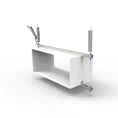


In the realm of modern construction and infrastructure development, seismic safety has emerged as a paramount concern. Earthquakes, with their unpredictable nature and potential for catastrophic damage, pose a significant threat to buildings, bridges, and various engineering structures. To mitigate these risks, seismic support systems have become indispensable components in ensuring the resilience of critical facilities during seismic events. As a leading supplier of seismic support series, I am excited to delve into the shock - absorption features that make our products stand out in the market.
The Importance of Shock - Absorption in Seismic Supports
Before we explore the specific shock - absorption features, it's crucial to understand why shock - absorption is so vital in seismic support systems. During an earthquake, the ground experiences rapid and violent movements. These movements generate powerful forces that can cause structures to sway, vibrate, and potentially collapse. Seismic supports are designed to counteract these forces by providing stability and absorbing the shock energy generated during seismic activity.
Effective shock - absorption can prevent or minimize damage to the supported structures, protect occupants and equipment, and reduce the overall economic impact of an earthquake. It allows buildings and infrastructure to withstand seismic forces without suffering catastrophic failure, ensuring that essential services can continue to operate even after a major earthquake.
Key Shock - Absorption Features of Our Seismic Support Series
1. High - Performance Dampers
One of the core shock - absorption features of our seismic support series is the use of high - performance dampers. These dampers are engineered to dissipate seismic energy by converting it into heat. They work by providing resistance to the movement of the supported structure during an earthquake.
There are different types of dampers used in our products, such as viscous dampers and friction dampers. Viscous dampers contain a viscous fluid that resists the movement of a piston. As the structure moves during an earthquake, the piston moves through the fluid, and the internal friction of the fluid dissipates the energy. Friction dampers, on the other hand, rely on the friction between two surfaces to absorb energy. When the structure moves, the frictional force between the surfaces converts the seismic energy into heat, reducing the amplitude of the vibrations.
The high - performance dampers in our seismic support series are designed to be highly reliable and durable. They can withstand repeated seismic events without losing their effectiveness, ensuring long - term protection for the supported structures.
2. Flexible Mounting Systems
Another important shock - absorption feature is our flexible mounting systems. These systems allow the seismic supports to adapt to the movement of the structure during an earthquake. They are designed to provide a certain degree of flexibility while still maintaining the stability of the support.
The flexible mounting systems use materials with high elasticity, such as rubber or elastomers. These materials can deform under the influence of seismic forces and then return to their original shape once the forces are removed. This flexibility helps to absorb the shock energy and reduce the stress on the supported structure.


For example, in our Longitudinal Seismic Support On The Water Pipe Side, the flexible mounting system allows the water pipes to move slightly during an earthquake without breaking. This not only protects the pipes but also ensures the continuous supply of water, which is crucial for firefighting and other essential services during and after an earthquake.
3. Energy - Dissipating Structures
Our seismic support series also incorporates energy - dissipating structures. These structures are designed to absorb and disperse seismic energy through their unique geometric shapes and material properties.
For instance, some of our supports use curved or corrugated structures. These shapes increase the surface area available for energy dissipation and allow the structure to deform in a controlled manner during an earthquake. As the structure deforms, it absorbs the seismic energy and reduces the forces transmitted to the supported equipment or building.
In addition, the materials used in these energy - dissipating structures are carefully selected for their high strength and ductility. Ductile materials can undergo large deformations without fracturing, which is essential for effectively absorbing seismic energy.
4. Tuned Mass Dampers (TMDs)
In some of our more advanced seismic support products, we utilize Tuned Mass Dampers (TMDs). TMDs are devices that consist of a mass, a spring, and a damper. They are tuned to the natural frequency of the structure to which they are attached.
During an earthquake, the TMD oscillates in the opposite direction to the movement of the structure. This counter - oscillation helps to reduce the amplitude of the structure's vibrations, effectively absorbing and dissipating the seismic energy. TMDs are particularly effective in reducing the dynamic response of tall buildings and long - span bridges, which are more susceptible to large - amplitude vibrations during seismic events.
Our TMDs are precisely engineered to ensure optimal performance. They are carefully calibrated to match the specific characteristics of the supported structure, providing maximum shock - absorption and vibration control.
Shock - Absorption in Different Types of Seismic Supports
1. Longitudinal Seismic Support On The Water Pipe Side
The Longitudinal Seismic Support On The Water Pipe Side is designed to protect water pipes from seismic damage. It features a combination of high - performance dampers and flexible mounting systems.
The dampers in this support help to absorb the longitudinal forces generated during an earthquake, preventing the pipes from breaking or being displaced. The flexible mounting system allows the pipes to move slightly in the longitudinal direction, reducing the stress on the pipes and their joints. This ensures the integrity of the water supply system during and after an earthquake.
2. Longitudinal Seismic Support On The Air Duct Side
Similar to the water pipe support, the Longitudinal Seismic Support On The Air Duct Side is crucial for protecting air ducts. Air ducts are an important part of the ventilation system in buildings, and their damage during an earthquake can disrupt the air circulation and affect the indoor air quality.
Our support for air ducts uses shock - absorption features such as energy - dissipating structures and high - performance dampers. The energy - dissipating structures help to absorb the seismic energy and reduce the forces transmitted to the air ducts. The dampers provide additional resistance to the movement of the ducts, preventing them from being damaged by the seismic forces.
3. Electrical Lateral Seismic Support
The Electrical Lateral Seismic Support is designed to protect electrical equipment and wiring from lateral seismic forces. Electrical systems are critical for the operation of buildings, and their failure during an earthquake can lead to power outages and other safety hazards.
Our electrical lateral seismic support incorporates shock - absorption features such as flexible mounting systems and TMDs. The flexible mounting system allows the electrical equipment to move slightly in the lateral direction, reducing the stress on the equipment and its connections. The TMDs help to control the vibrations of the equipment, ensuring its stability and functionality during and after an earthquake.
Conclusion and Call to Action
In conclusion, the shock - absorption features of our seismic support series play a crucial role in protecting buildings, infrastructure, and equipment from seismic damage. Our high - performance dampers, flexible mounting systems, energy - dissipating structures, and TMDs work together to effectively absorb and dissipate seismic energy, reducing the risk of catastrophic failure during an earthquake.
Whether you are involved in the construction of a new building, the renovation of an existing structure, or the installation of critical infrastructure, our seismic support series can provide the reliable and effective protection you need. We are committed to providing high - quality products and excellent customer service.
If you are interested in learning more about our seismic support series or have any questions regarding seismic safety, please do not hesitate to contact us. We look forward to discussing your specific needs and helping you find the best seismic support solutions for your projects.
References
- Chopra, A. K. (2007). Dynamics of Structures: Theory and Applications to Earthquake Engineering. Prentice Hall.
- Kelly, J. M. (1997). Earthquake - Resistant Design with Rubber. Springer.
- ATC - 40. (1996). Seismic Evaluation and Retrofit of Concrete Buildings. Applied Technology Council.