


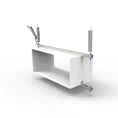


As a seasoned provider of cable tray accessories, I've witnessed firsthand the critical role that cable guides play in ensuring the efficient and safe installation of cable trays. Cable guides are not just simple add - ons; they are essential components that help organize cables, prevent damage, and enhance the overall functionality of cable tray systems. In this blog, I'll delve into the installation requirements for cable tray cable guides as accessories.
1. Structural Compatibility
Before installing cable guides, it's crucial to ensure that they are compatible with the existing cable tray structure. Cable trays come in various types, such as ladder - type, ventilated trough, and solid bottom. Each type has its unique design and load - bearing capacity.
For ladder - type cable trays, cable guides should be designed to fit securely between the rungs. They need to be sturdy enough to hold the cables in place without causing any stress on the ladder structure. The mounting holes on the cable guides should align precisely with the holes on the ladder rungs to allow for easy installation using appropriate fasteners.
Ventilated trough cable trays, on the other hand, require cable guides that can be attached to the sides of the trough. These guides should be able to withstand the weight of the cables and any potential lateral forces without detaching from the trough. Solid bottom cable trays demand cable guides that can be mounted on the flat surface, either by using screws or adhesive, depending on the design of the guide and the tray.
2. Cable Capacity and Spacing
Another important installation requirement is considering the cable capacity and spacing. Cable guides are designed to hold a specific number and size of cables. When installing them, you need to calculate the total number of cables that will pass through the guide and ensure that it has sufficient capacity.
For example, if you are dealing with a large number of small - diameter cables, you may need a cable guide with multiple compartments or a wider design to accommodate them all. On the contrary, if you have a few large - diameter cables, a more robust and wider - spaced cable guide would be appropriate.
Proper cable spacing is also essential. Cables should be spaced evenly within the cable guide to prevent overcrowding, which can lead to overheating and reduced cable performance. The spacing requirements may vary depending on the type of cables (e.g., power cables, data cables) and the industry standards. For instance, in a data center environment, strict spacing rules are often in place to minimize electromagnetic interference between cables.
3. Environmental Conditions
The environmental conditions where the cable tray and cable guides will be installed play a significant role in the installation requirements. If the installation is in a harsh industrial environment with high levels of dust, moisture, or chemicals, the cable guides need to be made of materials that can withstand these conditions.
For example, in a chemical plant, cable guides made of corrosion - resistant materials such as stainless steel or fiberglass - reinforced plastic (FRP) are recommended. These materials can resist the corrosive effects of chemicals and ensure the long - term durability of the cable guides.
In outdoor installations, cable guides need to be weather - resistant. They should be able to withstand extreme temperatures, UV radiation, and precipitation. UV - stabilized plastics or coated metal cable guides are suitable for such environments. Additionally, in areas prone to seismic activity, the cable guides need to be installed in a way that they can withstand vibrations and movements without losing their functionality.


4. Installation Location and Orientation
The location and orientation of the cable guides within the cable tray system are also important. Cable guides should be installed at regular intervals along the length of the cable tray to provide adequate support for the cables. The intervals may depend on the type and weight of the cables. For heavy - duty power cables, the intervals may be shorter compared to light - weight data cables.
The orientation of the cable guides is also crucial. They should be installed in a way that allows for easy cable routing. For example, in a complex cable tray network with multiple branches, the cable guides should be oriented to direct the cables smoothly towards their intended destinations. In some cases, special types of cable guides such as Screw Vertical Left Tee or Lower Vertical Tee for Screw may be required to handle vertical or angled cable routing.
5. Safety and Accessibility
Safety is always a top priority when installing cable tray cable guides. The installation process should not create any hazards for the installers or the future maintenance personnel. All fasteners should be tightened properly to prevent the cable guides from coming loose, which could pose a risk of cable damage or even electrical accidents.
Accessibility is also important. Cable guides should be installed in a way that allows for easy inspection and maintenance. In case of cable replacement or addition, the cable guides should be accessible without having to disassemble large parts of the cable tray system. For example, some cable guides are designed with removable covers or snap - on features to facilitate easy access to the cables.
6. Compatibility with Other Accessories
Cable guides often need to work in conjunction with other cable tray accessories. For example, they may need to be compatible with cable tray bends, elbows, and tees. When installing cable guides near these accessories, it's important to ensure that there is no interference.
The cable guides should be able to align properly with the adjacent accessories to allow for seamless cable routing. In some cases, you may need to use specialized cable guides such as Lower Corner Vertical Tee to ensure compatibility at corners or intersections of the cable tray system.
Conclusion and Call to Action
In conclusion, the installation requirements for cable tray cable guides as accessories are multifaceted. From structural compatibility and cable capacity to environmental conditions and safety, every aspect needs to be carefully considered to ensure a successful installation.
As a reliable cable tray accessories supplier, we offer a wide range of high - quality cable guides that meet all the installation requirements mentioned above. Our products are designed and manufactured to the highest industry standards, ensuring durability, functionality, and safety.
If you are planning a cable tray installation project and need cable guides or other cable tray accessories, we invite you to contact us for procurement and further discussion. Our team of experts is ready to assist you in selecting the right products for your specific needs.
References
- National Electrical Code (NEC)
- International Electrotechnical Commission (IEC) standards
- Manufacturer's installation manuals for cable trays and accessories