


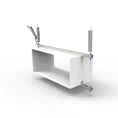


When it comes to cable management systems, one of the key considerations for any project is the long - term maintenance cost. As a supplier of fiberglass cable trays, I've witnessed firsthand the varying perspectives and concerns that customers have regarding the upkeep of different types of cable trays. In this blog post, I'll delve into how the maintenance cost of fiberglass cable trays compares to other types.


Understanding Different Types of Cable Trays
Before we jump into the maintenance cost comparison, let's briefly touch on the common types of cable trays available in the market.
- Steel Cable Trays: These are perhaps the most traditional type of cable trays. Steel is known for its strength and durability. It can withstand heavy loads and is commonly used in industrial settings where robustness is a priority. However, steel is prone to corrosion, especially in harsh environments.
- Aluminum Cable Trays: Aluminum cable trays are lightweight and have good corrosion resistance. They are often used in applications where weight is a concern, such as in high - rise buildings or on offshore platforms. But aluminum can be more expensive than steel in some cases, and it may require special handling during installation.
- Fiberglass Cable Trays: Fiberglass cable trays are made from a composite material that combines glass fibers with a resin matrix. They come in various types, such as Fiberglass Tray Type Cable Tray, Fiberglass Ladder Type Cable Tray, and Fiberglass Trough Type Cable Tray. Fiberglass cable trays offer excellent corrosion resistance, are lightweight, and have good electrical insulation properties.
Maintenance Cost Factors
1. Corrosion Resistance
- Steel Cable Trays: As mentioned earlier, steel is highly susceptible to corrosion, especially in environments with high humidity, exposure to chemicals, or saltwater. To prevent corrosion, steel cable trays often require regular painting or the application of anti - corrosion coatings. The cost of these coatings, along with the labor required for application and re - application over time, can add up significantly. For example, in a coastal industrial plant, the steel cable trays may need to be repainted every 2 - 3 years, which involves not only the cost of paint but also the downtime for the maintenance work.
- Aluminum Cable Trays: Aluminum has a natural oxide layer that provides some level of corrosion resistance. However, in certain aggressive environments, such as those with high levels of acidic or alkaline substances, this oxide layer can be compromised. Special anodizing or coating treatments may be required to enhance the corrosion resistance of aluminum cable trays. While these treatments are generally less frequent than for steel, they still contribute to the overall maintenance cost.
- Fiberglass Cable Trays: Fiberglass is inherently corrosion - resistant. It can withstand a wide range of environmental conditions, including exposure to chemicals, moisture, and UV radiation, without significant degradation. This means that in most cases, fiberglass cable trays do not require any anti - corrosion treatments. Over the long term, this can result in substantial savings on maintenance costs, especially in harsh industrial or coastal environments.
2. Structural Integrity
- Steel Cable Trays: Over time, steel cable trays can experience structural degradation due to factors such as corrosion, heavy loads, and mechanical stress. This may lead to issues like bending, warping, or even breakage. Repairing or replacing damaged steel cable trays can be expensive, as it often involves cutting, welding, and the use of specialized equipment. In addition, the weight of steel can make installation and replacement more labor - intensive.
- Aluminum Cable Trays: Although aluminum is lightweight, it can still be affected by mechanical stress and fatigue. In high - vibration environments, aluminum cable trays may develop cracks or loose connections. Repairing these issues may require specialized tools and techniques, which can increase the maintenance cost.
- Fiberglass Cable Trays: Fiberglass cable trays have excellent strength - to - weight ratios. They are resistant to mechanical stress and can maintain their structural integrity over a long period. In the rare event of damage, fiberglass cable trays can often be repaired more easily and cost - effectively than steel or aluminum trays. Minor repairs can be done using simple fiberglass repair kits, which are relatively inexpensive.
3. Cleaning and Inspection
- Steel Cable Trays: Steel cable trays can accumulate dirt, dust, and debris over time. Cleaning them can be a challenging task, especially if they are installed in hard - to - reach areas. In addition, the rough surface of painted steel can make it more difficult to remove contaminants. Regular inspections are also necessary to detect signs of corrosion or structural damage, which adds to the maintenance cost.
- Aluminum Cable Trays: Similar to steel, aluminum cable trays also require regular cleaning to maintain their appearance and functionality. The smooth surface of aluminum may make cleaning slightly easier, but inspections are still required to check for signs of damage or corrosion.
- Fiberglass Cable Trays: Fiberglass cable trays have a smooth surface that is easy to clean. A simple wipe - down with a mild detergent and water is usually sufficient to keep them clean. Inspections are also less frequent, as the corrosion - resistant and durable nature of fiberglass reduces the likelihood of sudden failures.
Long - Term Cost Comparison
To illustrate the long - term cost differences, let's consider a hypothetical industrial project with a lifespan of 20 years.
- Steel Cable Trays: Assuming an initial cost of $10,000 for the steel cable trays, and factoring in the cost of anti - corrosion coatings every 3 years (estimated at $2,000 per application), structural repairs every 5 years (estimated at $3,000 per repair), and regular cleaning and inspection costs (estimated at $500 per year), the total maintenance cost over 20 years would be approximately $18,500, bringing the total cost of ownership to around $28,500.
- Aluminum Cable Trays: With an initial cost of $12,000, anti - corrosion treatments every 5 years (estimated at $1,500 per treatment), structural repairs every 7 years (estimated at $2,500 per repair), and cleaning and inspection costs of $400 per year, the total maintenance cost over 20 years would be approximately $10,300, resulting in a total cost of ownership of around $22,300.
- Fiberglass Cable Trays: Starting with an initial cost of $11,000, minimal cleaning and inspection costs (estimated at $200 per year), and occasional minor repairs (estimated at $1,000 over 20 years), the total maintenance cost over 20 years would be approximately $5,000, bringing the total cost of ownership to around $16,000.
Conclusion
In conclusion, when comparing the maintenance cost of fiberglass cable trays to other types, it's clear that fiberglass offers significant advantages. Its corrosion resistance, structural durability, and ease of maintenance result in lower long - term costs. As a fiberglass cable tray supplier, I believe that choosing fiberglass cable trays is a smart investment for any project that requires reliable and cost - effective cable management.
If you're considering a cable tray solution for your next project, I encourage you to contact us to discuss your specific needs. We can provide you with detailed information about our fiberglass cable trays and help you make an informed decision.
References
- "Cable Tray Handbook" - A comprehensive guide on cable tray selection and maintenance.
- Industry reports on the performance and cost - effectiveness of different cable tray materials.